
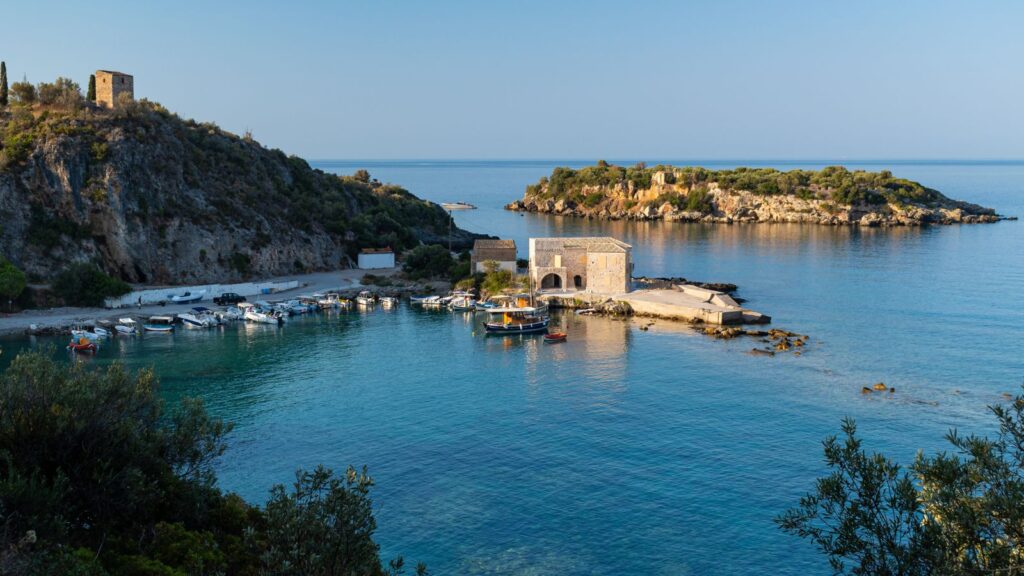
The Mani Peninsula: The Complete Guide to Southern Greece's Wild Coast
The Mani Peninsula is the middle "finger" of the Peloponnese in southern Greece, a narrow strip of stone villages, clear water, and mountain trails between the Messinian and Laconian Gulfs. This guide covers everything you need to plan a trip: where it is, how to get there, when to go, which village to base yourself in, and what there is to actually do once you arrive.
Quick Facts: Mani Peninsula at a Glance
- Location: Southern tip of the Peloponnese, Greece, between the Messinian Gulf (west) and Laconian Gulf (east)
- Nearest airport: Kalamata International Airport (KLX). See the current Kalamata Airport flight schedule
- Getting there from the UK and Europe: Direct seasonal flights to Kalamata on easyJet, Jet2, Ryanair, British Airways, Wizz Air, Condor, Eurowings, and others
- Driving time from Kalamata Airport: About 57 minutes to Kardamyli (26 miles), 66 minutes to Stoupa (31 miles), and just under 2 hours to Areopoli (54 miles)
- Alternative route: Fly into Athens and drive south, around 3 to 3.5 hours to West Mani
- Best time to visit: Late April to June and September to October, when the sea is warm, the hiking weather is comfortable, and the crowds are thin
- Busiest months: July and August
- Quietest months: November to March, when many smaller guesthouses and tavernas close for the season
- Main regions: Outer Mani (Exo Mani) in the north, Inner or Deep Mani (Mesa Mani) in the south, and Lower Mani on the eastern, Laconian Gulf side
- Key villages: Kardamyli, Stoupa, Areopoli, Limeni, Oitylo, Gerolimenas, Porto Kagio, Gythio
- Known for: Stone tower houses, olive groves, the Diros Caves, Cape Tainaron (the mythological gateway to the underworld), the Viros Gorge, and a coastline with some of the clearest water in Greece
- Language and currency: Greek (English is widely spoken in tourist areas); euro (€)
Where Is the Mani Peninsula?
The Mani sits in the southern Peloponnese, hanging between the Messinian Gulf to the west and the Laconian Gulf to the east, with the Taygetos mountain range running down its spine. It's reached by road from Kalamata in the north or from the town of Gythio in the east. There's no single "Mani" town. It's a region made up of dozens of small villages, which is part of why picking a base is the first real decision in planning a trip.
The Three Regions of the Mani
Locals and guidebooks generally split the peninsula into three areas, and knowing them helps you choose where to stay.
- Outer Mani (Exo Mani): The greener, more accessible northern section on the Messinian Gulf side, running roughly from Kalamata down to Stoupa. Villages here, including Kardamyli and Stoupa, are well served by tavernas and shops and make an easy starting point for first-time visitors.
- Inner or Deep Mani (Mesa Mani): The wilder, rockier southern tip, centred around Areopoli, Limeni, Gerolimenas, and Porto Kagio near Cape Tainaron. This is where the famous stone war towers and the most dramatic, sparsely populated landscape are found.
- Lower Mani: The Laconian Gulf side, facing east, including Gythio, the old sponge-fishing port that now serves as the region's main eastern gateway.
How to Get to the Mani Peninsula
By air: The closest airport is Kalamata International (KLX), which has expanded significantly in recent years. For the 2026 season it's running around 31 direct routes to roughly 22 destinations across the UK, Germany, and wider Europe, on carriers including easyJet, Jet2, Ryanair, British Airways, Wizz Air, Condor, Eurowings, and Austrian. From Kalamata airport, it's about a 1-hour drive to Kardamyli, just over an hour to Stoupa, and closer to 2 hours to reach Areopoli or the Deep Mani villages. Check the current flight schedule before booking, since routes are seasonal.
Via Athens: If you're not flying direct, Athens International Airport is the other option, followed by a rental car or bus for the roughly 3 to 3.5-hour drive south into the Mani.
Getting around once there: A rental car is close to essential. Public transport between villages is limited, and much of what makes the Mani worth visiting, from small coves to tower villages to mountain roads, is only really reachable by car. Local taxi and transfer services are available for those without one; see tourism services in the Mani.
When to Visit the Mani Peninsula
- Late April to June: Warm sea, wildflowers, green hills, and comfortable hiking temperatures. Most places are open and crowds are light.
- July and August: Peak season. Hot, busy, and lively. Book accommodation well ahead, especially in Kardamyli and Stoupa.
- September and October: Widely considered the best window. The sea is still warm from summer, temperatures have eased, and the crowds have thinned out.
- November to March: Quiet and atmospheric, but many smaller hotels, guesthouses, and tavernas close for the winter, particularly in the smaller Deep Mani villages. Kalamata, Areopoli, and Gythio stay livelier year-round.
What to Do in the Mani Peninsula
Beaches and the sea. The Mani's coastline alternates between long sandy stretches near Stoupa and Kardamyli and small, quiet pebble coves further south toward Gerolimenas and Porto Kagio. Boat trips are a popular way to see coves that aren't reachable by road; see boat trips in the Mani.
Hiking. The Taygetos range and the Viros Gorge, starting near Kardamyli, offer some of the best hiking in the Peloponnese, from short coastal paths to full-day mountain routes. See outdoor activities for guided options.
History and architecture. The Mani is known for its stone tower houses, built by clans for defence during centuries of local feuding, most visible in the Deep Mani villages around Areopoli. The region also played a defining role in the Greek War of Independence. On 17 March 1821, around 12,000 Maniots gathered in Areopoli and declared war on the Ottoman Empire, roughly a week before the rest of Greece rose up.
The Diros Caves. One of the peninsula's best-known attractions: a system of limestone caves near Areopoli, explored partly by boat along an underground lake.
Cape Tainaron (Cape Matapan). The southernmost point of mainland Greece, reached via Porto Kagio. In Greek mythology, a cave here was said to be one of the entrances to the underworld, the passage Heracles used to drag Cerberus up to the surface as his final labour, and the route Orpheus took to try to bring Eurydice back. Today it's a quiet lighthouse walk with dramatic views. Read more in Tainaron: The Gates of Hades.
Food and drink. Maniot cuisine centres on olive oil, wild greens, cured pork (siglino), and simple seafood, served in family-run tavernas rather than resort-style restaurants. Browse where to eat in the Mani.
Where to Stay in the Mani Peninsula
Accommodation ranges from boutique hotels and restored stone tower houses to self-catering villas and simple studios near the beach.
- Kardamyli and Stoupa (Outer Mani) have the widest range of hotels, apartments, and restaurants, making them the easiest bases for a first visit or a trip without a car for part of the stay.
- Areopoli and Limeni (Deep Mani) suit travellers who want to be closer to the Diros Caves, the tower villages, and the wilder southern coastline.
- Gythio (Lower Mani) works well as a base for exploring the Laconian Gulf side and connecting onward to Monemvasia and the rest of Laconia.
See the full range of accommodation in the Mani, including villas and suites, hotels, and guesthouses.
Practical Tips
- Language: Greek is the local language, but English is widely spoken in hotels, tavernas, and shops across the main villages.
- Currency: Euro (€). Card payments are accepted in most hotels and larger restaurants, but smaller tavernas and shops in remote villages may be cash only.
- Driving: Roads into Deep Mani are narrow, winding, and mountainous in places, so allow more time than a map suggests, especially after dark.
- Connectivity: Mobile coverage and Wi-Fi are generally reliable in the main villages, patchier in remote coastal spots and on mountain trails.
- Opening seasons: Many smaller guesthouses, tavernas, and shops outside Kardamyli, Stoupa, Areopoli, and Gythio operate seasonally, roughly April or May through October. Confirm opening dates directly if you're visiting in the off-season.
Frequently Asked Questions
Where exactly is the Mani Peninsula?
The Mani is the central of the three "fingers" of the southern Peloponnese in Greece, sitting between the Messinian Gulf to the west and the Laconian Gulf to the east.
What is the nearest airport to the Mani Peninsula?
Kalamata International Airport (KLX), roughly 1 to 2 hours by road from the main Mani villages depending on which one you're heading to. See the current flight schedule.
Do I need a car in the Mani Peninsula?
Yes, for the most part. Public transport between villages is limited, and much of the region's appeal, from small coves to mountain villages to tower settlements, is only accessible by road.
What is the difference between Outer Mani and Deep Mani?
Outer Mani (Exo Mani) is the greener, more accessible northern part around Kardamyli and Stoupa. Deep or Inner Mani (Mesa Mani) is the wilder, rockier southern section around Areopoli and Gerolimenas, known for its stone tower villages.
When is the best time to visit the Mani Peninsula?
Late April to June and September to October, for warm weather, a swimmable sea, and fewer crowds than the July to August peak.
Is the Mani Peninsula good for families?
Yes. Kardamyli and Stoupa in particular have sandy beaches, a good range of family-friendly accommodation, and short distances between villages, restaurants, and the sea.
What is the Mani Peninsula known for?
Its stone architecture and defensive tower houses, its role in the 1821 Greek War of Independence, the Diros Caves, Cape Tainaron, and a rugged coastline with some of the clearest water in the Peloponnese.
For village-specific detail, browse all Mani Peninsula listings or explore individual locations including Kardamyli, Stoupa, Areopoli, and Gythio.
Search
Categories
- Accommodation
- Activities
- Architecture
- Areopoli
- Awards
- Beaches
- Community
- Culture
- Destination Highlights
- Discover
- Entertainment
- Food
- Gerolimenas
- Greek Cuisine
- Guide
- Gythio
- History
- Hotels
- Kardamili
- Kardamyli
- Kotronas
- Living in Mani Greece
- Local Business
- Mani
- Marine Life
- Marmari
- Nature
- News
- Off-the-Beaten-Path
- Stoupa
- Sustainability
- Tradition
- Travelling
- Villas
- Wildlife