
Quick Facts
- What it is: Gerolimenas is a small coastal village built around a natural harbour at the southern tip of the Mani Peninsula, in the municipal unit of Oitylo, East Mani, Laconia, Peloponnese, Greece.
- Population: 88 residents (2021 census, including the nearby settlement of Ochia)
- Name origin: Popularly read in modern Greek as "old harbour," but the name is thought to derive from the ancient "Hieros Limen," meaning "sacred harbour"
- History: A remote fishing hamlet reached mainly by boat until the 1970s, Gerolimenas grew into a trading port around 1870, shipping local produce, including quail, to Western Europe; the first steamship on the Kalamata to Piraeus line called there in 1875
- Nearest landmark: Cape Tainaron (Cape Matapan), the southernmost point of mainland Greece, about 17 km south via the village of Kokkinogeia
- Getting there: About 23 km, roughly 25 minutes, from Areopoli; about 115 km, roughly 2 to 2.5 hours, from Kalamata International Airport
- Best for: A quiet harbourside base for exploring the deep Mani, Cape Tainaron, and Vathia, away from the busier resorts further north
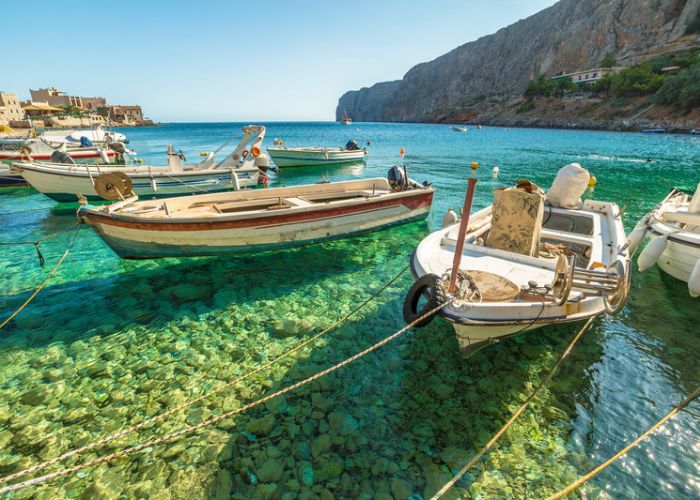
Gerolimenas, Greece doesn't try very hard to be noticed, which is more or less the point. The village sits at the end of a long, narrow bay near the bottom of the Mani Peninsula, ringed by bare grey mountains that run straight into the sea, and for most of its history the easiest way in was by boat. Cars changed that eventually, but Gerolimenas still feels like the last stop before the peninsula runs out of land.
A Harbour Built on Trade
Gerolimenas was one of the more isolated settlements in the Peloponnese until the 1970s, when a proper road finally reached it. Before that, boats did the work that trucks do now. The village's fortunes turned around 1870, when local merchants began using its sheltered harbour to ship produce, most notably quail, north to Kalamata and on to markets in Western Europe. In 1875, the steamship running the Kalamata to Piraeus line made its first call at Gerolimenas, and for a few decades the village had a working shipyard, an ice supply, and a fish market to match its trade in grain and game.
That economy didn't last much past the mid-20th century, and the buildings that once stored grain and salted fish stood empty for years afterward. Several have since been restored rather than replaced, which is why Gerolimenas today looks less like a resort built for tourism and more like a working harbour that quietly changed jobs. The old warehouses along the water are stone, low, and built to survive weather rather than impress visitors, and that's largely still true of the village.
What Gerolimenas Looks Like Today
Gerolimenas today is a single row of restored stone buildings curved around a harbour where fishing boats still tie up alongside the odd sailboat passing through. There's no real town centre beyond the waterfront itself: a scatter of tavernas and rooms to let, most converted from the old trading warehouses, facing a bay that turns from pale turquoise to deep blue depending on the light. The drive in from the north, along the coast road from Areopoli, gives a preview of what's ahead, since the landscape gets starker and the villages smaller the further south you go.
Behind the village, the hills climb toward Kokkinogeia and, eventually, Cape Tainaron. In front of it, the water is clean enough for swimming straight off the rocks near the harbour, without needing to find a proper beach. It's a place people tend to use as a base rather than a destination in itself, which suits it fine.
Things to Do in and Around Gerolimenas
The single best reason to base yourself in Gerolimenas is Cape Tainaron, the southernmost point of mainland Greece and the second-southernmost point on the European mainland after Punta de Tarifa in Spain. The drive from Gerolimenas to the trailhead at Kokkinogeia is about 17 km, after which a rocky path of roughly 2 to 3 km leads out to the lighthouse at the tip, a walk that takes most people 40 to 50 minutes each way. The lighthouse itself, a 16-metre tower built by the French Navy in 1882 with a range of 22 nautical miles, is closed to visitors, but the walk out passes small coves, the ruins of a Temple of Poseidon, and a Roman-era mosaic near the start of the trail. Everything Mani's listing for Mani Hiking covers guided walking routes across this stretch of the peninsula for anyone who'd rather not navigate the path alone.
South of Gerolimenas, the abandoned tower-house village of Vathia is about 10 km away and worth the detour even as a short stop. Everything Mani's guide to Areopoli has more detail on Vathia's roughly 70 stone towers and why the village emptied out. In the other direction, Porto Kagio, a former pirate anchorage turned quiet fishing bay, sits close to Cape Tainaron and makes a reasonable lunch stop or overnight alternative if Gerolimenas is full; Everything Mani lists Psamathous Guesthouse there.
For a change of pace, the neighbouring village of Alika, a few minutes back toward Areopoli, has its own cluster of accommodation and one of the better tables in the area. Anyone planning an active few days should also check Everything Mani's current tours, boat trips, and outdoor activities listings, several of which cover this end of the peninsula.
Where to Stay in Gerolimenas
Gerolimenas has two places to stay directly in the village, and both occupy restored harbour buildings rather than purpose-built hotels. Kyrimai, Mani's foremost historic hotel, is set in a fully restored 19th-century trading complex dating to the 1870s, on the same stretch of harbour where the old grain trade once ran. The Kyrimis family, who restored it, kept the original stone and wood throughout; the old wine storage room is now reception, and the former wood store houses a small archive of documents and books uncovered during the renovation. The hotel has 23 rooms across the complex, along with its own restaurant serving Maniot dishes built around a revived version of the low, round sofra table.
Gerolimenas Hotel, next door in the same harbour, is a smaller, family-run alternative built from three converted stone towers dating to the 1950s. It has 21 rooms, most with sea views toward Cape Grosso, and sits right beside the village's own swimming spot. Breakfast runs from 8:00 to 11:30am in the adjoining restaurant.
For more options nearby, Everything Mani's Alika listings include Alika Resort and Alika Pure Zen Home, both a short drive back up the coast road, and the site's wider accommodation category covers converted tower houses and villas elsewhere on the peninsula.
Where to Eat in Gerolimenas
Both hotels in the village run their own restaurants, and Kyrimai's is the more ambitious of the two, working traditional Maniot ingredients (wild greens, cured pork, local olive oil) into a menu that leans more modern than most tavernas this far south. Gerolimenas Hotel's restaurant, next to the beach, keeps things simpler and serves breakfast through late morning for guests and passersby alike.
For dinner with a bit more range, Matapan, a wine bistro in nearby Alika, is worth the short drive, pairing a serious wine list with food built around the same local produce. Everything Mani's restaurant category lists further options across the wider Areopoli and Mani area for anyone touring rather than staying put.
Getting to Gerolimenas, Greece
The nearest airport is Kalamata International (KLX), about 115 km away, which usually works out to somewhere between 2 and 2.5 hours by car depending on the route and how many stops you make along the way. Everything Mani's Kalamata Airport Flight Schedule is worth checking before booking, since routes and frequency change by season. From Areopoli, the closest town of any size and the traditional capital of the Mani, it's about 23 km, roughly a 25-minute drive down the coast road.
There's no train into this part of the Peloponnese and no regular bus service reaching all the way to Gerolimenas, so a hire car is the practical way in for most visitors. Everything Mani lists car rental, taxi, and transfer services for anyone arriving without their own transport, and Everything Mani's guide to Areopoli is a useful stop for context on the wider region before continuing south, along with the site's full Mani Peninsula travel guide.
FAQ
Is Gerolimenas worth visiting?
Yes, particularly for travellers who want a quieter base than Kardamyli or Stoupa. Gerolimenas offers direct access to Cape Tainaron, Vathia, and Porto Kagio, along with two restored harbour hotels and swimming straight off the rocks in the village itself.
How far is Gerolimenas from Cape Tainaron?
It's about 17 km by road to the trailhead at Kokkinogeia, followed by a rocky path of roughly 2 to 3 km to the lighthouse at the cape itself, a walk of around 40 to 50 minutes each way.
What does the name Gerolimenas mean?
It's commonly read in modern Greek as "old harbour," though the name likely comes from the ancient "Hieros Limen," meaning "sacred harbour."
How do I get from Kalamata Airport to Gerolimenas?
It's about 115 km, usually a 2 to 2.5 hour drive by car, taxi, or private transfer. There's no train or direct public bus, so most visitors arrange a hire car or transfer in advance.
Is Gerolimenas the same as Cape Tainaron?
No. Gerolimenas is a village about 17 km north of the Cape Tainaron trailhead. Cape Tainaron is the headland and lighthouse at the very southern tip of the peninsula, reached from Gerolimenas by road and then on foot.
Search
Categories
- Accommodation
- Activities
- Architecture
- Areopoli
- Awards
- Beaches
- Community
- Culture
- Destination Highlights
- Discover
- Entertainment
- Food
- Gerolimenas
- Greek Cuisine
- Guide
- Gythio
- History
- Hotels
- Kardamili
- Kardamyli
- Kotronas
- Living in Mani Greece
- Local Business
- Mani
- Marine Life
- Marmari
- Nature
- News
- Off-the-Beaten-Path
- Stoupa
- Sustainability
- Tradition
- Travelling
- Villas
- Wildlife